This guest post was written by a friend who is frustrated, angry and tired over a process this is supposedly there to help her. She wanted a platform to share her story and I was more than willing to do what I could. While creating a baby for some is as easy as one fun night, for others it's not as simple. And for other's yet, it's a painstaking journey...
We have been going through this crazy process to try to make a baby—build our family. We are two thirty-something women, who have been together for over 11 years, married for over 5 years, own our own house (or at least the bank does for another 20+ years), live in semi-rural New England with our two cats, have post-graduate degrees, and a huge community of loving friends and family that support us from one mile down the road to the West Coast, across the globe, and many places in between. We are financially stable, have good professions, physically healthy, and emotionally (in general) stable. We are culturally Jewish and identify with spiritual teachings from many religions, including Judaism. We have a garden that can sometimes successfully group tomatoes and squash, and we often forget, or simply don’t make the time, to weed.
Our lives have included their fair share of strife and difficulties, just like many, if not most, other people; and at times we have dealt with it better than others. But trying to make a baby has been no small feat. First off- we had to decide on where we would get our sperm. After debating known versus anonymous donor, we opted for a cousin, so that our child would be biologically related to both of us. I am going to be the birth mother with my partner’s cousin’s sperm. We had only the most positive experience and response when discussing this with her cousin- him wanting nothing more than to help us have children. I am ever so grateful for his loving kindness. Now to get the sperm to my egg… he lives out of town, so if he isn’t in town, we have it shipped, overnight, in a kit that keeps it viable for 24-48 hours (thank you gayspermbank.com).
Either we inseminate at home, or I go to my midwife who washes it, spins it, and inserts it past my cervix [Intrauterine Insemination (IUI)]. We know the timing, or hope we get the timing right, because I chart my temperatures and cycles daily, pee on ovulation predictor kits (OPKs) every so often, and sometime I even go and get an ultrasound to quadruple check. This is all because I am blessed with irregular cycles, for which they have found no known direct cause other than possibly Polycystic Ovarian Syndrome (PCOS), although blood tests do not confirm this diagnosis.
So we have been doing this for 20+ months. Friends I was trying to get pregnant with are celebrating their babies’ one-year birthdays. Please, don’t hear that as complaining- it is wonderful to celebrate their lives and it is also a reminder of how long and difficult this has all been.
We started with one midwifery clinic and had an awful, unprofessional experience there. One midwife reprimanded me (for what I still don’t understand), while I was in the stirrups butt naked. She ended up taking a leave and has retired early—something that validates my experience and saddens me for her difficulties. We switched to another midwife center and have received loving, compassionate, and accepting care. I text my midwife when I get a positive OPK and we schedule via texting. We share 1-2 hours a month while she cleans the sperm and I warm the wash.
After six months of trying on our own and 14 months of IUIs, we decided to consult a the local hospital’s reproductive medicine center to see what our next options were. Having completed one cycle of clomid that made me feel so crazy that I thought I was going to jump off a bridge, I needed to know other options. We met with Dr. L, who immediately told us what my health insurance would cover before laying an eye on me. We told her we had a known donor who had been tested for STIs and HIV and with whom I had been inseminating with for 20 months. She commented, “You know we don’t like that here.” She did not look at my charts, my cycles, my medical history, or my wife in the eye. She told us to go right to IVF (In Vitro Fertilization) and switch to an anonymous donor because it would be more efficient. As if our donor decision has not been well thought out and emotionally involved.
Dr. L stated numerous excuses as to why they would not work with us with a known donor unless we quarantined the sperm ($) at a sperm bank ($$) for six months to test it twice ($$$) for STIs, and then freeze the sperm and ship it ($$$$) to their facility. She said it was a waste to do it that way because it would cost over $5,000. [Which at this point in time I would pay $5k for a child in a heartbeat.] I will comment that the actual cost of this is more like $3,000, but the fact that it is put off for six months just because I am not married to him feels ridiculous. Dr. L explained that due to the guidelines that the hospital follows, while a heterosexual couple could move immediately to IVF, a lesbian couple has to quarantine the sperm for six months, even if the individual has been exposed to the sperm prior to IVF. Basically, if I had to come to the clinic with just the donor and we said we wanted to have a child I would have moved to IVF IMMEDIATELY without having to pay any such sperm bank costs.
We argued these points, but to no avail. We were met with even more blatant discrimination (oh did you know, by the way, that sperm banks certified by the ASRM [American Society of Reproductive Medicine]- which this clinic only accepted sperm from- you can’t be a gay male—or rather you can’t have had sex with a male in the past 5 years. There are hundreds of other rules too about being out of the country, so on and so forth, but having sex with a male was #1). Then there was Dr. L’s comment about how we needed to go to counseling (I’m a psychologist) to deal with our “issue.” I inquired about the subject of “issue”—my infertility or the way we are choosing to make our family and was told the latter. And don’t let me forget the moment where my wife told the doctor that we knew it was not her intention exactly, but we felt discriminated against by her actions. She replied, “It’s okay for you to feel that way.”
Dr. L claimed that they could not separate the social (my state-recognized marriage) from the medical (my inseminations with the donor) because they had a “moral obligation.” She explained this with an example of a family in which children had been removed from the home and how the hospital would have a moral obligation not to offer that couple IVF. We, as two women with a known donor, were being compared to a family in which children were removed from the home for abuse and/or neglect. This was Dr. L’s attempt to have a “mutual agreement” as to why the hospital would eventually deny us equal services that would have been offered had I been a married heterosexual woman, a single woman with a male partner, or had I simply just come in with the donor and said that we wanted to have a child (a.k.a. lied—kind of like we are forced to do on our federal tax forms, but I digress…).
Needless to say, they denied us services for what we believe is discrimination based on how we are choosing to create a family. She neglected to send us her policies as we requested and it took over four weeks for me to get a copy of the records I requested and testing I had done there. They charged me $3.25 for the copies after billing my insurance company over $1,000 for the two 30-minute visits and even more for testing. (I had a Hysterosalpingogram [HSG] done and while they gave me a time to arrive, they took me 90 minutes later than my scheduled time. When I inquired, I was told to take deep breaths and relax (have I mentioned I am also a trained yoga instructor?), even though a sign in the waiting room stated “if you are not taken within 15 minutes of your scheduled appointment, please inquire with the receptionist.” Oh, and I was told to take 800 mg of Ibprofen 30-minutes before the procedure which I was now concerned was beginning to wear off.)
Finally we are done with this clinic, and while we are considering letter writing or letters to the editor, we cannot expend our energy on it until we have a child. We really just want a baby - one that is of both of our genetics, and for some reason this is so confusing to the reproductive medicine center at our local hospital.
So we try a second reproductive clinic. This one is two hours away with a satellite office one hour away. We don’t hesitate to go. We are treated with significantly more respect—find out that the owner/medical director is an out gay male—and are allowed to more forward with IVF, with just a few stipulations. 1) We need a contract by a lawyer, reviewed by my wife’s cousin’s lawyer, stating the financial/parental responsibility of the to be child; 2) the donor needs to attend one session of counseling to prove that he knows he is making this decision (have I mentioned that he is a scientist, his father a lawyer and his mother a psychologist?); 3) he needs to have blood tests, again, within 7 days of depositing his sample or “donation” if you will- he has to freeze his donation ($) so that they can ship it ($$) to our facility; 4) I need to have additional genetic testing and infectious disease screening, as well as proof that I have been vaccinated and/or exposed to a host of childhood diseases. I have already had 2 rounds of genetic testing, 3 rounds of hormonal panels, 2 rounds of thyroid panels, 2 rounds of glucose screening, 3 rounds of infectious disease screening, and 2 rounds of blood type screening; 5) I need to have a physical within one year of IVF- apparently they only really need to listen to my lungs and heart, and even though all the reproductive doctors are physicians (and wear stethoscopes around their necks), none can listen to my heart and lungs without a separate appointment; 6) pap smear within a year (thankfully I did that!); 7) hormonal panel on day three of cycle (done!); 8) uterus cavity examination (I have had not just one but two of these) and… screeching halt… 12 cycles of IUI with three cycles using follicular stimulating hormones. Well, even though I have been trying for 20 months, thus exposed to sperm for 20 months, there is a chance that my health insurance company won’t accept that and that they will only count IUIs and unfortunately I have only had 10. (Again, if I were hetero- no problemo!). Oh, and even though I ovulate on my own without difficulty (irregularly, but only 1 out of 18 cycles have been anovulatory), they want to stimulate the heck out of my ovaries so that my hormones are out of whack for the two months BEFORE IVF. I was recently put on an anti-diabetes drug (metformin) for the PCOS. I am hoping that the insurance company will count that because I start a new job next month and the following month my wife has ACL surgery, so I really don’t want to go crazy for all of that. (By the way, my mom has breast cancer and went through surgery, chemotherapy, and now radiation while I was going through all this, finishing a doctoral program, writing and defending a dissertation, my wife had her ski accident, and more people in my life died than I can easily count.) It has been a year of trauma, topped off with disappointment, frustrations, stress, and discrimination.
So here we are, I’m in weekly acupuncture, taking herbs, trying to prepare my body for an onslaught of hormones, waiting to hear what my insurance company, not my doctor or midwife, will dictate about my treatment. I have to get permission from more adults in power for making a wanted child and yet 16 year olds are not taught about protected intercourse and find themselves unknowingly and unwittingly pregnant with little support from anyone, let alone the FDA, ASRM, or any other institution. Why is the government so interested in making this so difficult for us but not in preventing children from mistakes that can’t be undone?
Yes, I am frustrated. I’m sure it is partially a mask for the sadness and monthly disappointment. I don’t know how much longer I can do this and yet I can’t imagine not having children. Three ideally, although I can’t see myself doing this part again. My new mom and pregnant friends have told me that the nine months feels like forever. At this point, it doesn’t feel so long.
I’m not saying that it should be perfectly easy for two women to have children. I’m the first to admit that this isn’t supposed to be simple. I chose to marry a woman (note language here) but I didn’t choose to be discriminated for it. I just think that Dr. L could have been kinder. It was so clear we made her uncomfortable—but I’m a human and like many others that she has helped get pregnant, I want a child. She wasn’t thinking of what my experience was because she was too stuck in her own discomfort to see past it to ours.
I never expected it to take this long and yet somehow I trust that when we finally have a child, it will all feel right that we had to wait this long. I know that there are children out there, whether born yet or just in spirit, that will choose us as parents. I just wish that institutions didn’t get in the way quite so much.
At this point, I would happily take twins because it would mean we were done with this process. Happily.
In closing, it has been emotionally tolling and draining—but it will all be worth it when we hold that child in our arms for the first time.
Abigail Levy, a pseudonym used by the author to protect her identity, is a psychotherapist and has been married to her spouse for 5 years. They reside in New England. A shorter version of Abigail's story originally appeared in The Rainbow Times.

Showing posts with label Guest Post. Show all posts
Showing posts with label Guest Post. Show all posts
Thursday, September 8, 2011

Wednesday, August 31, 2011
An Abortion Story
Krista, who I met via my This Is What A Feminist Looks Like series, graciously agreed to do a guest post for me, especially after I had found out that she had been a patient of the late Dr. George Tiller. Krista originally shared this post as a speech at a Planned Parenthood event.
In 1986 I was 15-years-old and I was pregnant.
That's an easy statement to make now, but it was a reality that took me months to accept.
I was in love. I honestly thought I was going to spend the rest of my life with him....until he broke up with me.
The next month my period didn't come. I thought it was because I was upset over the break-up.
The month after that, I was in denial. It couldn't happen to me. We had been safe....most of the time.
The month after that I accepted I was pregnant.
But I wasn't allowed to date yet, so how was I going to tell my parents I was pregnant?
When I finally told them they were angry, disappointed and concerned.
We talked about my future and what I wanted.
I wanted to go to college. And I knew I was not ready to be a mother at 15-years old.
My mother took me to the Planned Parenthood in Peoria Illinois.
After an examination the doctor said he could not perform the abortion.
I was more than 21-weeks pregnant.
Our only alternative was to travel to Wichita Kansas and the Women's Health Care Services clinic.
The same clinic Operation Rescue and other anti-choice protesters targeted for years.
When we pulled up to the gated clinic only one silent protestor stood outside.
I was relieved, but I was also scared.
The staff was kind. They smiled and treated me and the six others in my group gingerly.
They were other teenagers like me.
There was a 20-year old beauty pageant queen. She told me she was getting an abortion because the Miss America rules stated she could not have a child.
There was a couple in their 30's who made the difficult decision to terminate a planned pregnancy because the child was stricken with a severe birth defect.
The same birth defect that had already claimed one of their children.
And there was a 12-year-old Hispanic girl who didn't speak English. She looked terrified.
The staff explained that over the next week we would take pills to induce labor and abort our fetuses.
We all stayed at a local motel.
We ate together, we cried together and we supported each other.
My contractions started in the middle of the afternoon.
I couldn't keep food or water down.
The pain increased as the contractions got closer together.
By the next morning I was in agony.
I don't remember much about the moment when my pregnancy ended.
Just the nurse who told me to push.
On the long drive home, my breasts started producing milk. My body believed I had given birth.
Before we left the clinic, the Doctor talked to all of us about our futures.
When the Doctor looked at me he paused and quietly said I reminded him of his daughter.
My doctor was Dr. George Tiller.
In 2004, I saw Dr. Tiller again at the March for Women's Lives in Washington D.C.
I cried and thanked him for giving me a future.
I felt empowered knowing he was on our side.
On May 31, 2009 Scott Roeder shot and killed Dr. George Tiller.
The doctor was at his church serving as an usher during the Sunday morning service when Roeder shot Dr. Tiller in the head.
That single gunshot closed the Women's Health Care Services clinic permanently.
I want Dr. Tiller's legacy to be something he said, "Abortion is about women's hopes and dreams and potential, the rest of their lives, abortion is a matter of survival for women.
 |
| Krista at 15 |
In 1986 I was 15-years-old and I was pregnant.
That's an easy statement to make now, but it was a reality that took me months to accept.
I was in love. I honestly thought I was going to spend the rest of my life with him....until he broke up with me.
The next month my period didn't come. I thought it was because I was upset over the break-up.
The month after that, I was in denial. It couldn't happen to me. We had been safe....most of the time.
The month after that I accepted I was pregnant.
But I wasn't allowed to date yet, so how was I going to tell my parents I was pregnant?
When I finally told them they were angry, disappointed and concerned.
We talked about my future and what I wanted.
I wanted to go to college. And I knew I was not ready to be a mother at 15-years old.
My mother took me to the Planned Parenthood in Peoria Illinois.
After an examination the doctor said he could not perform the abortion.
I was more than 21-weeks pregnant.
Our only alternative was to travel to Wichita Kansas and the Women's Health Care Services clinic.
The same clinic Operation Rescue and other anti-choice protesters targeted for years.
When we pulled up to the gated clinic only one silent protestor stood outside.
I was relieved, but I was also scared.
The staff was kind. They smiled and treated me and the six others in my group gingerly.
They were other teenagers like me.
There was a 20-year old beauty pageant queen. She told me she was getting an abortion because the Miss America rules stated she could not have a child.
There was a couple in their 30's who made the difficult decision to terminate a planned pregnancy because the child was stricken with a severe birth defect.
The same birth defect that had already claimed one of their children.
And there was a 12-year-old Hispanic girl who didn't speak English. She looked terrified.
The staff explained that over the next week we would take pills to induce labor and abort our fetuses.
We all stayed at a local motel.
We ate together, we cried together and we supported each other.
My contractions started in the middle of the afternoon.
I couldn't keep food or water down.
The pain increased as the contractions got closer together.
By the next morning I was in agony.
I don't remember much about the moment when my pregnancy ended.
Just the nurse who told me to push.
On the long drive home, my breasts started producing milk. My body believed I had given birth.
Before we left the clinic, the Doctor talked to all of us about our futures.
When the Doctor looked at me he paused and quietly said I reminded him of his daughter.
My doctor was Dr. George Tiller.
In 2004, I saw Dr. Tiller again at the March for Women's Lives in Washington D.C.
I cried and thanked him for giving me a future.
I felt empowered knowing he was on our side.
On May 31, 2009 Scott Roeder shot and killed Dr. George Tiller.
The doctor was at his church serving as an usher during the Sunday morning service when Roeder shot Dr. Tiller in the head.
That single gunshot closed the Women's Health Care Services clinic permanently.
I want Dr. Tiller's legacy to be something he said, "Abortion is about women's hopes and dreams and potential, the rest of their lives, abortion is a matter of survival for women.
 |
| Krista today |
Krista is married to an amazing, supportive man. They have two dogs who fill their lives with joy. You can find Krista on Twitter.
Wednesday, August 17, 2011
Food, Farming & Feminism
This was a guest post I originally wrote for my friend Ashley's blog, Small Strokes.
Planting seeds, pulling weeds and harvesting greens...on the surface these activities hardly scream feminism, but when you dig a bit deeper, it's almost hard to miss the strong connection between food, farming and feminism. For me, it all boils down to a sense of self-sustainability: if I'm able to grow some crops and turn them into something both edible and nourishing, I've added just one more way to ensure both my independence and ability to take care of myself. There is also the slight satisfaction I get (beyond biting into a tomato picked straight from the vine!) knowing I that excel at something that is traditionally a male endeavor.
This is the third year that we've planted our small urban vegetable garden.

I can then take my veggies and herbs and turn them into delicious, healthy meals for myself and my family. While some might scoff at what I do and suggest that I'm conforming to a '50s ideal of the wife who stays home and cooks for her family, I find that it's completely the opposite for me.
Instead of playing into a stereotype, I'm actively transforming the notion of what a homemaker is with my little garden. I'm taking the power back, working hard, and choosing to eat my own produce rather than patronizing big box stores. Like the feminists of the '60s, '70s & '80s, I'm driven by the desire for self-sufficiency and autonomy as well as achieving personal satisfaction. Yet instead of heading out to the office, I head to my garden.
The idea of small and even urban homesteads has only grown in recent years, with women raising backyard chickens, planting gardens and learning skills that had been put to the wayside for most, like canning, spinning yarn, baking bread from scratch, etc... Various books and articles have even been written about these women, showing that most have either Masters and Doctorates but choose instead to see their workspace within the home rather than outside of it. Author Shannon Hayes even went as far as coining the term "Radical Homemaker," when explaining this phenomenon and sharing the stories of women living this life.
This idea of radical homemaking is not just for the middle-upper class, however. Every week I head to a nearby inner city to tutor teen moms who are working towards their GED. I'm there once a week, and in the short time I spend with them, I invariably get into discussions about their food choices. Bags of Doritos, piles of Slim Jims, huge bottles of soda and fast food containers litter their desks. The girls are quick to remind me that these choices are cheap and quick. I remind them that they have access to wonderful community gardens right there in the city (and even one tended to by the program they're in). While I may not change their eating habits overnight, they do get excited about the prospect of being able to grow their own food and control that aspect of their lives - something essential for these young women, many of whom feel that their lives have spun out of control.
As for me? While I do still work part-time, albeit from home, the rest of my time is spent with my son either in the garden or working with the bounty we reap from it. In the summer we can freshly picked strawberry jam and in the winter we bake fresh bread. It instills a sense of pride in me that I'm teaching my young son all of these tasks as well. As a feminist, ensuring that he not only knows, but appreciates and enjoys having these skills is important to me. One day, hopefully, he will be the one wowing his family with blueberry pie and homemade pretzels. For now he's just happy getting his feet dirty along with me and eating broccoli straight from the stalk.
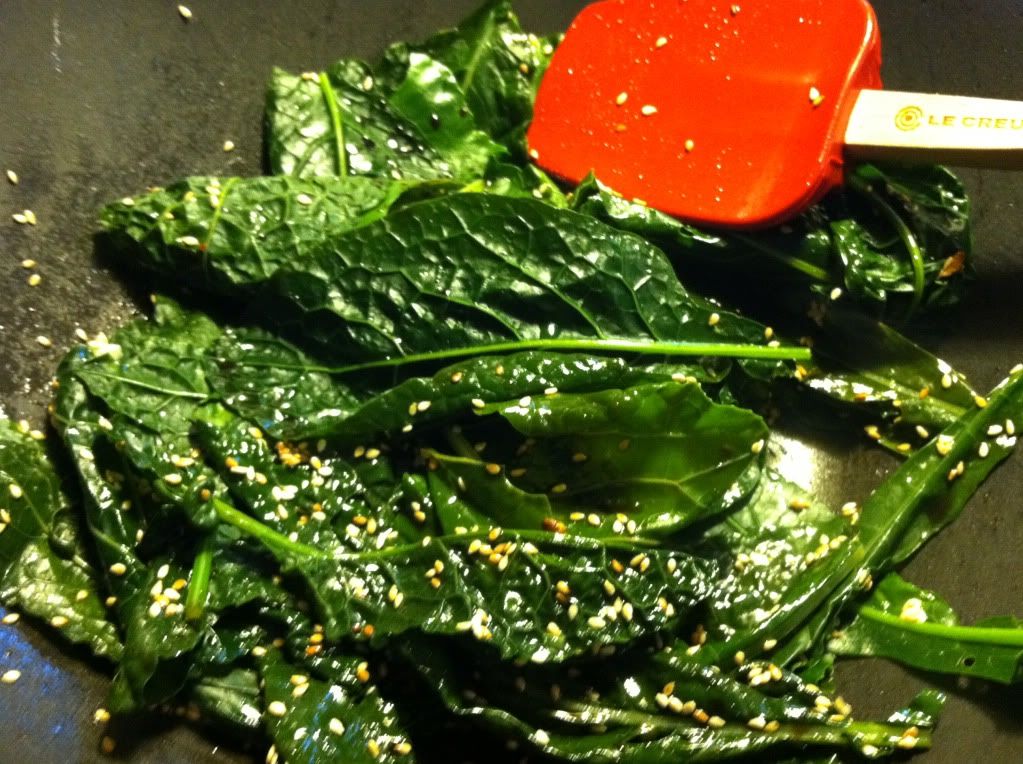
This is my favorite way to eat kale (or any hardy green!). It’s both easy and super quick, making a great side to any meal. (You can also put some tofu or a fried egg on top of it and bam! - the perfect meal). It’s also pretty awesome because you can always change up the flavor profile (instead of tamari/soy sauce/sesame seeds you can use a little chili powder & cumin and add some black beans).
Wash and steam some kale. My favorite, which we grow in our garden, is dino kale. I don’t have a fancy steamer and instead just tear up a bunch of kale, add it to a saute pan with a bit of water and cover. Let it cook for no more than 5 minutes. You want the greens to still be a bright color and not super wilted and mushy.
While the greens are cooking, toast a handful of sesame seeds in a wok. Add 2 teaspons of olive oil, a couple of cloves of minced garlic and a tablespoon of either tamari or soy sauce. Once the garlic is cooked through, turn off heat and mix in kale. Delish.

Planting seeds, pulling weeds and harvesting greens...on the surface these activities hardly scream feminism, but when you dig a bit deeper, it's almost hard to miss the strong connection between food, farming and feminism. For me, it all boils down to a sense of self-sustainability: if I'm able to grow some crops and turn them into something both edible and nourishing, I've added just one more way to ensure both my independence and ability to take care of myself. There is also the slight satisfaction I get (beyond biting into a tomato picked straight from the vine!) knowing I that excel at something that is traditionally a male endeavor.
This is the third year that we've planted our small urban vegetable garden.
 |
| MD tending to our kale |
We don't have an actual yard or lawn, and instead ripped out the few ornamental bushes the previous owners planted. With only a six by ten square foot plot of dirt surrounded by bricks, I'm able to grow broccoli, various types of tomatoes, cucumbers, green beans, lettuce, kale, basil and mint.

I can then take my veggies and herbs and turn them into delicious, healthy meals for myself and my family. While some might scoff at what I do and suggest that I'm conforming to a '50s ideal of the wife who stays home and cooks for her family, I find that it's completely the opposite for me.
Instead of playing into a stereotype, I'm actively transforming the notion of what a homemaker is with my little garden. I'm taking the power back, working hard, and choosing to eat my own produce rather than patronizing big box stores. Like the feminists of the '60s, '70s & '80s, I'm driven by the desire for self-sufficiency and autonomy as well as achieving personal satisfaction. Yet instead of heading out to the office, I head to my garden.
The idea of small and even urban homesteads has only grown in recent years, with women raising backyard chickens, planting gardens and learning skills that had been put to the wayside for most, like canning, spinning yarn, baking bread from scratch, etc... Various books and articles have even been written about these women, showing that most have either Masters and Doctorates but choose instead to see their workspace within the home rather than outside of it. Author Shannon Hayes even went as far as coining the term "Radical Homemaker," when explaining this phenomenon and sharing the stories of women living this life.
This idea of radical homemaking is not just for the middle-upper class, however. Every week I head to a nearby inner city to tutor teen moms who are working towards their GED. I'm there once a week, and in the short time I spend with them, I invariably get into discussions about their food choices. Bags of Doritos, piles of Slim Jims, huge bottles of soda and fast food containers litter their desks. The girls are quick to remind me that these choices are cheap and quick. I remind them that they have access to wonderful community gardens right there in the city (and even one tended to by the program they're in). While I may not change their eating habits overnight, they do get excited about the prospect of being able to grow their own food and control that aspect of their lives - something essential for these young women, many of whom feel that their lives have spun out of control.
As for me? While I do still work part-time, albeit from home, the rest of my time is spent with my son either in the garden or working with the bounty we reap from it. In the summer we can freshly picked strawberry jam and in the winter we bake fresh bread. It instills a sense of pride in me that I'm teaching my young son all of these tasks as well. As a feminist, ensuring that he not only knows, but appreciates and enjoys having these skills is important to me. One day, hopefully, he will be the one wowing his family with blueberry pie and homemade pretzels. For now he's just happy getting his feet dirty along with me and eating broccoli straight from the stalk.
 |
| EZ's dirty toes circa 2009 |
Killer Kale
This is my favorite way to eat kale (or any hardy green!). It’s both easy and super quick, making a great side to any meal. (You can also put some tofu or a fried egg on top of it and bam! - the perfect meal). It’s also pretty awesome because you can always change up the flavor profile (instead of tamari/soy sauce/sesame seeds you can use a little chili powder & cumin and add some black beans).
Wash and steam some kale. My favorite, which we grow in our garden, is dino kale. I don’t have a fancy steamer and instead just tear up a bunch of kale, add it to a saute pan with a bit of water and cover. Let it cook for no more than 5 minutes. You want the greens to still be a bright color and not super wilted and mushy.
While the greens are cooking, toast a handful of sesame seeds in a wok. Add 2 teaspons of olive oil, a couple of cloves of minced garlic and a tablespoon of either tamari or soy sauce. Once the garlic is cooked through, turn off heat and mix in kale. Delish.
Tuesday, August 2, 2011
The Kid Argument
Mamafesto note: This essay was written as part of a blog-post exchange with the fabulous Ashley Lauren. I had the opportunity to write something for her, and she so graciously crafted this piece on her choice to remain childless.
* * *
When my husband, Tim, and I got married, I didn’t change my name. Reactions to this ranged from shock and dismay to a pat on the back, though nothing got to me more than what I started to refer to as the Kid Argument.
“Well, that’s fine for you and all, but don’t you want to share a name with your children?”
Behold, the Kid Argument.
What’s wrong with this question? you might ask. It’s a legitimate question. Think of how inconvenient it would be to go to parent-teacher conferences or a hospital and have someone question the relationship you have with your child.
Sure, if that’s your only frame of reference, it is a legitimate question, but there are so many things wrong with that statement that I don’t know if I can fit them all into one blog post. But, since Avital was so gracious to allow me into her space today to talk about feminism and parenting, I thought I’d use the time to offer a different perspective: the feminist non-parent.
Here’s the first thing that’s wrong with the Kid Argument: It assumes my unborn children have to have their father’s last name. For that matter, it assumes any child has to have their father’s last name. Personally, I don’t think it’s out of the question to demand – after 9 months of carrying around another human being inside of me, allowing that human being to demand my entire attention (not to mention all of my energy and most of my food intake), giving up wine and coffee for the duration of my pregnancy and while breastfeeding, and after pushing that baby out of me (or, even scarier, having a C-section) – that this child has my last name. Or, at the very least, a hyphen that includes my name. Admittedly, when Tim and I were first discussing whether or not I would change my name, he was a little hesitant simply because he didn’t quite know how that would look or how it would shape our lives in years to come. He had simply never experienced that in his lifetime, since his parents shared a name. At that time, I told him that if we had kids, they could have his name and I didn’t really care; my decision to keep my name was for me, not for anyone else. After all, my mom and I don’t share a last name since her and my dad got divorced, and it doesn’t make me less her daughter and, plus, she’s always just been Mom to me. However, the more I thought about it, the more I thought, no way! If I have to go through all that being pregnant stuff, the kid will have my name.
But what do kids do when their names are hyphenated, you might ask? If I choose option one to respond to the Kid Argument, this is almost always the follow-up question. Sometimes it looks like: Won’t that be a mouthful for your kid? or What if it’s a girl; what will she do when she gets married? Have three last names? These questions – especially the last one – elicit a major facepalm from me. Seriously? If I have a girl, or if I have a boy, and they ever choose to get married, they can do whatever they want. Keep it, get rid of it, combine it, change it all together – I don’t care! That’s their choice to make with their partner, just like it was mine to make with Tim. As far as the mouthful of a name, I’m a teacher and I know kids with one last name that has more letters and definitely more awkward combinations of consonants than our hyphenated name would be and those kids are just fine, so I think we’re OK there.
The second assumption embedded in the Kid Argument (and this is the one that really gets to me) is that I want to – or even am able to – have children. Here’s the thing: I don’t. We don’t. We’ve talked a lot about it and we just don’t want kids. We love kids; we’re both teachers, so it would follow that kids bring joy to our lives, but we both feel strongly that, after dealing with students all day, it would be really difficult to come home and give our full attention to a child. We also really want to do things. I want to write a book, he wants to run marathons, we want to travel, spend time together, sleep through the night. You get the picture. While we can imagine having kids is incredibly rewarding and worth making sacrifices to some people, it isn’t to us. At least, not right now.
You can imagine all of the follow-up arguments to this one, right? Oh, don’t worry, you’ll change your mind. (I wasn’t worried, thanks, and I might change my mind, but why would you invalidate my hopes and desires like that?) Just get your head and heart in the right place and the rest will follow. (Meaning my head and heart aren’t in the right place now by saying I want to spend time with my husband and do different things with my life? Thanks a lot.) You know the number one reason couples get divorced is because one partner wants kids and the other doesn’t. (Are you seriously trying to tell me my husband will leave me if I don’t ever change my mind? Wow…) You can’t always plan it, you know. (Well… uh… hmm… OK, well you’ve got me there. And if we had a little surprise bundle of joy, we’d be really great parents, but that doesn’t mean we can’t try to plan it.) It really is enough to make your head spin, and that’s just the tip of the iceberg.
I’ve written a lot about us not wanting kids (and here, too), us adopting kids, us having only one kid if any at all. The bottom line, though, is that Tim and I are going to structure our family however it works for us, whether it’s just the two of us and the dog, or whether we have a little (hyphenated) bundle of joy. Tim and I get to choose this together, and experience it together, and that is truly what feminism is all about.
Ashley Lauren is a 27-year-old feminist, social activist, blogger, freelance writer, and full-time high school English teacher. This stuff keeps her busy. She keeps her own blog, Small Strokes, about being a married feminist and how she navigates those murky waters. She also occasionally blogs there about teaching, because being a feminist teacher is sometimes tougher than being a feminist wife. She is also a Senior Editor for Gender Across Borders, a global feminist blog. She has walked in seven 2-day Avon Walks for Breast Cancer with her mom, is entering her sixth year of teaching, has her Bachelors degree in English Literature and Creative Writing with a teaching certificate, and completed her masters in English Studies in May 2010. You can also follow her on Twitter or email her at samsanator (at) gmail (dot) com.
Subscribe to:
Posts (Atom)
